
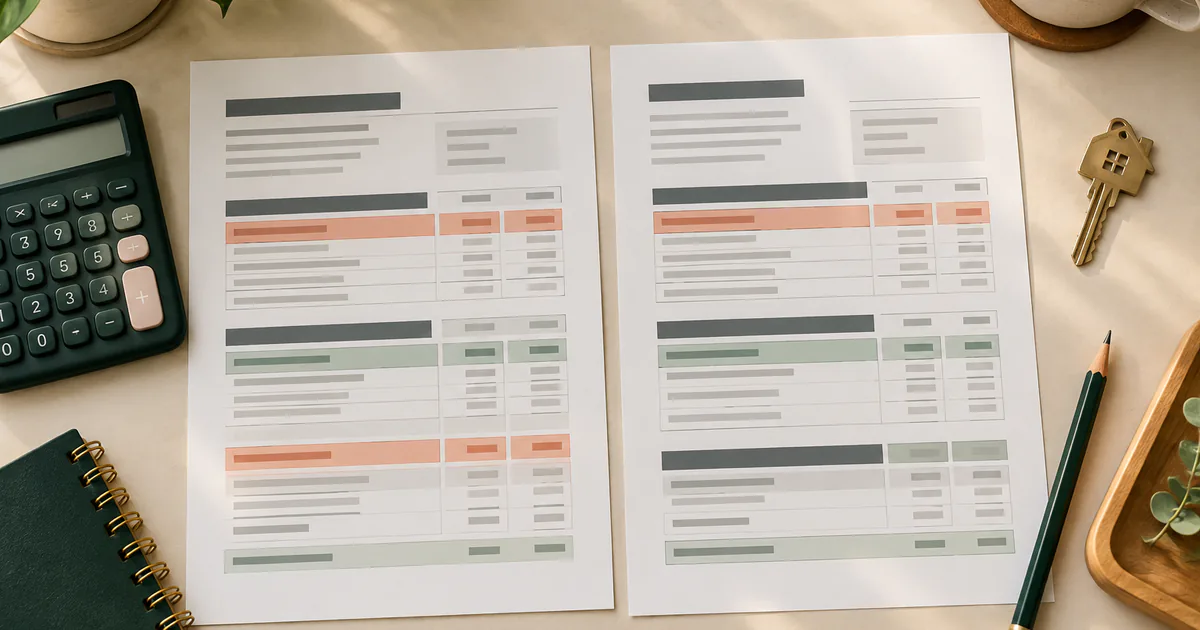
The choice in one sentence
A broker comparison is useful only when the loan scenario and timing are held constant. Rates move, underwriting differs and the lowest advertised number may require points or assumptions that do not match your file.
What to compare side by side
| Subject | Relationship | Evidence or action |
|---|---|---|
| Starting point | sets the basis for | A broker comparison is useful only when the loan scenario and timing are held constant. Rates move, underwriting differs and the lowest advertised number may require points or assumptions that do not match your file. |
| Scope and assumptions | is supported by | Verify individual and company NMLS records |
| Cost and trade-off | is tested with | Use an identical loan scenario |
| Written result | should include | Compare same-day Loan Estimates |
Understand who does what
A broker generally places a loan with a wholesale lender; a direct lender funds or closes loans through its own channel. Ask who controls underwriting, appraisal escalation, closing disclosures and the rate-lock extension decision. Next step: Trace broker compensation and loan credits.
Compare a complete price
For the same property, occupancy, down payment, credit profile and lock period, compare interest rate, annual percentage rate, points, lender credits, origination charges, broker compensation and cash to close. Record the time of each quote. Next step: Organise the inputs for a loan discussion.
Test lender access
Ask how many lenders are active for your loan type and how many were actually compared for your file. A large panel is not useful if only a small subset accepts the property, income or credit profile. Next step: Test a jumbo broker's actual lender access.
Plan for execution risk
Ask what happens if documents are delayed, an appraisal comes in low or the lock expires. Identify who communicates conditions and the expected response time. Service differences matter when the closing date is fixed. Next step: Prepare for lock and closing delays.
A fair comparison in practice
One offer has a lower rate but two discount points; another has a slightly higher rate with a lender credit. The relevant break-even is the upfront difference divided by monthly payment savings, adjusted for the household's realistic holding period - Not a universal winner.
Build your comparison record
- Verify individual and company NMLS records
- Use an identical loan scenario
- Compare same-day Loan Estimates
- Separate points from other fees
- Ask who controls underwriting
- Document lock and extension rules
Questions that settle the choice
Is a mortgage broker always cheaper than a direct lender?
No. Pricing depends on the loan scenario, timing, lender access, compensation, points and credits. Compare written estimates for the same scenario and lock period.
Why should mortgage quotes be compared on the same day?
Mortgage pricing can move with the market. A quote collected later may differ because of timing rather than because one channel is consistently cheaper.
Choose on evidence, not labels
- Verify individual and company NMLS records
- Use an identical loan scenario
- Compare same-day Loan Estimates
- Separate points from other fees
Primary sources
Build a controlled mortgage comparison
A channel comparison fails when the offers describe different loans or different moments in the market. Write the scenario once, send it to both parties and record when each price was produced. Then compare the documents and the team's ability to reach the closing date, not just the advertised rate.
| Variable | Hold constant | Why it matters |
|---|---|---|
| Loan structure | Amount, term, product and occupancy | These change pricing and qualification |
| Market timing | Same day and a recorded quote time | Rates and credits can move during the comparison |
| Lock | Same lock status and period | A floating quote is not equal to a locked offer |
| Upfront tradeoff | Same points or credit preference | Cash to close and monthly cost move together |
Freeze the scenario before requesting prices
Use the same property value, loan amount, down payment, occupancy, product type, term, credit assumptions and target lock period. Tell both parties whether discount points or lender credits are acceptable. If one quote changes an assumption, mark it rather than placing the offers side by side as if they were equivalent. A lower payment produced by a different loan amount is not a pricing advantage.
Keep an execution log as well as a price table
Record who controls underwriting, how conditions are communicated, when the appraisal is ordered and who can approve a lock extension. Ask for likely response times and the escalation contact for a fixed closing date. Service claims deserve evidence too: keep requested document lists, response timestamps and written explanations of changed terms.
This guide is general education, not individual financial, investment, insurance, mortgage, legal or tax advice.