
What this document can tell you
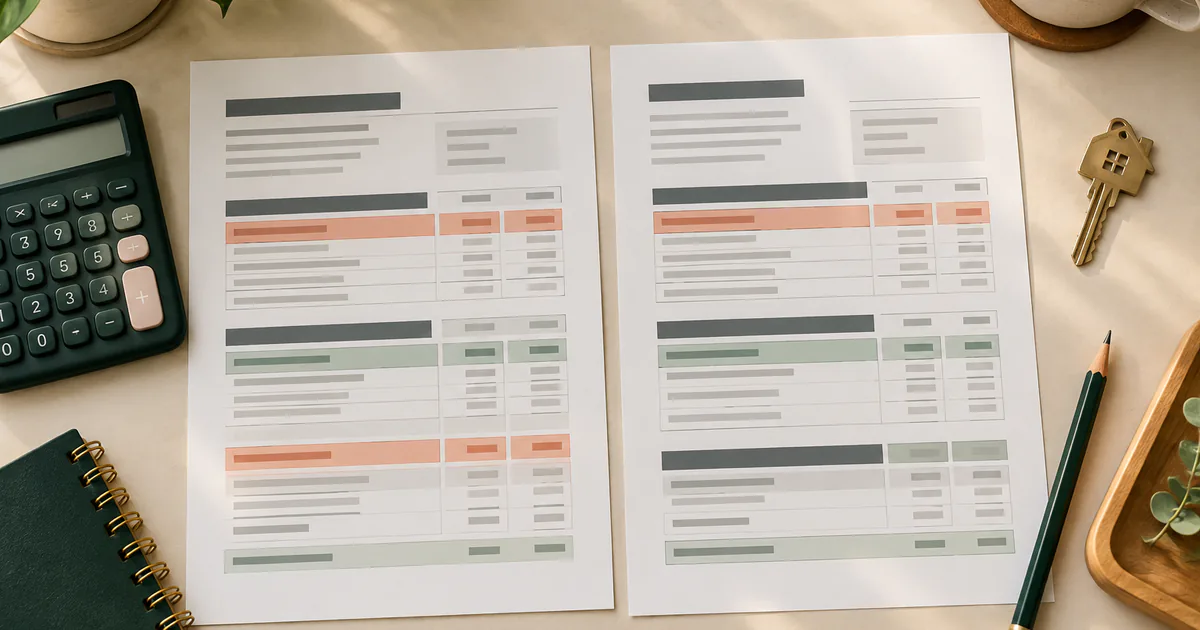
A useful Loan Estimate comparison holds the requested loan constant. Start with loan terms and timing, then compare lender-controlled charges, credits, cash to close and the five-year cost measure.
Your reading route
Make the scenarios match before comparing price
Check loan amount, term, purpose, product, rate type, occupancy, down payment and property details. Obtain estimates close together because market rates can move. Record whether each rate is locked, the lock period and the expiration of estimated closing costs. A lower rate from a different day or different product is not a clean comparison. Next step: Compare the lock terms behind each estimate.
Read page one for payment and cash pressure
Confirm principal and interest, mortgage insurance, estimated escrow and the estimated total monthly payment. Then review estimated closing costs and cash to close. Separate the down payment from loan costs so a difference in cash does not appear to be a lender price difference when it reflects another transaction assumption. Next step: Understand when private mortgage insurance may end.
Compare lender and lender-selected charges
On page two, compare total origination charges and services you cannot shop for. Look for discount points, underwriting, processing and lender credits. A lender credit can reduce upfront cost while being associated with a higher rate; points can raise upfront cost in exchange for a lower rate. Ask for alternatives using the same lock period. Next step: Organise inputs before requesting estimates.
Use page three without relying on one number
Review the APR and the 'In 5 years' comparison figures, but keep the likely holding period in view. APR is useful but depends on assumptions and does not replace the payment, cash-to-close or break-even analysis. Also confirm the loan officer and NMLS information against the person you are dealing with. Next step: Interpret APR and interest rate together.
Track every revision through closing
Keep each estimate and compare changed lines. Ask for the specific reason, date and supporting information behind a revision. Before closing, compare the final Closing Disclosure with the last accepted estimate and escalate unexplained changes before sending funds. Next step: Reconcile the final Closing Disclosure.
Follow one detail through the document
Offer A charges $3,200 more upfront and saves $68 per month compared with Offer B. The simple break-even is about 47 months. A household expecting to sell in three years may value the lower upfront cost, while a longer holding period could favour the lower payment. The comparison also checks lock length and service reliability before choosing.
Document review checklist
Your progress is stored only in this browser.
Primary sources
Questions about the document
Should I choose the estimate with the lowest APR?
Not automatically. APR is one cost measure. Also compare loan type, rate, payment, points, credits, cash to close, lock period, holding period and execution risk.
Can I use estimates issued on different days?
You can review them, but rate-market changes weaken a price comparison. Ask for updated estimates based on the same scenario and similar timing when possible.
Finish the review
- Match the complete loan scenario
- Record estimate time and lock status
- Compare total monthly payment
- Separate points and lender credits
Compare the fields lenders can actually price
Loan Estimates are most useful when the borrower facts and requested loan are the same. Confirm the core scenario first, then compare interest rate, points, lender credits, origination charges, lender selected services and the page three comparison figures. Treat taxes and insurance carefully because a low estimate for those items does not make the loan cheaper.
| Area | Compare | Do not assume |
|---|---|---|
| Loan terms | Amount, rate, payment, penalty and balloon features | A lower payment describes the same loan |
| Loan costs | Points, origination charges and required services | All closing costs are controlled by the lender |
| Cash to close | Credits, deposits and funds due | The lowest cash figure has the lowest long term cost |
| Comparisons | APR and five year cost figures | One summary number answers every tradeoff |
Annotate each estimate before choosing
Write the issue time, lock status, lock period and expiration next to the lender name. Check loan amount, term, purpose, product, rate type and whether risky features are marked. Highlight discount points, credits and origination charges separately. If one offer changes the product or down payment, request a corrected estimate before comparing totals.
Reconcile revisions instead of replacing the old copy
Keep every version. When a new estimate arrives, mark changed loan terms, costs and cash to close and ask what new information caused each change. Some amounts can move because the application or selected services changed, while other changes have specific rules. A dated trail gives the lender, housing counselor or regulator the information needed to review a dispute.
This guide is general education, not individual financial, investment, insurance, mortgage, legal or tax advice.